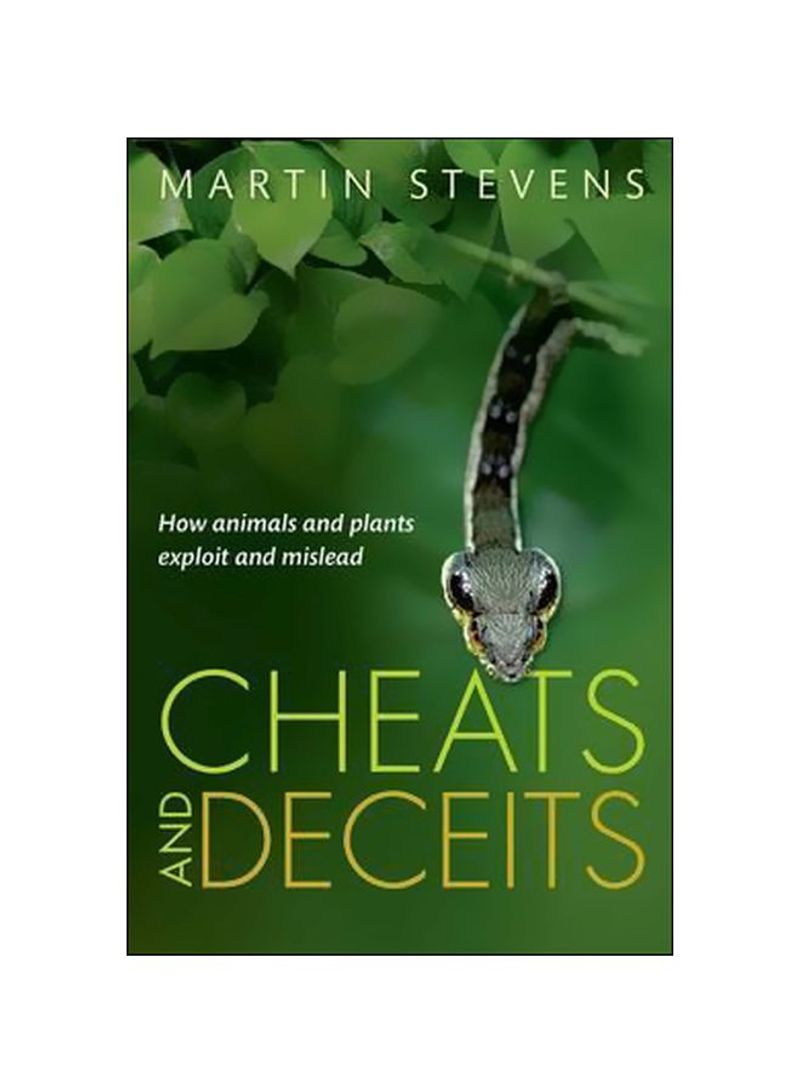


Cheats And Deceits: How Animals And Plants Exploit And Mislead Hardcover
Recommend
Sort by
Rating
Date

Specifications
Author 1
Martin Stevens
Book Description
In nature, trickery and deception are widespread. Animals and plants mimic other objects or species in the environment for protection, trick other species into rearing their young, lure prey to their death, and deceive potential mates for reproduction. Cuckoos lay eggs carefully matched to their host's own clutch. Harmless butterflies mimic the wing patterning of a poisonous butterfly to avoid being eaten. The deep-sea angler fish hangs a glowing, fleshy lure in front of its mouth to draw the attention of potential prey, while some male fish alter their appearance to look like females in order to sneak past rivals in mating. Some orchids develop the smell of female insects in order to attract pollinators, while carnivorous plants lure insects to their death with colourful displays.
ISBN-13
9780198707899
Language
English
Publisher
Oxford University Press
Publication Date
01-05-2016
Number of Pages
420
About the Author
Martin Stevens is Associate Professor of Sensory and Evolutionary Ecology based in the Centre for Ecology and Conservation, University of Exeter. His research focuses on sensory ecology and behaviour, especially animal coloration and vision. He studies a wide range of animals, including fish, reptiles, birds, insects, crabs, and primates. Martin's work has frequently covered topics related to deception, including mimicry by brood parasites and anti-predator coloration, including camouflage, eyespots, and mimicry. He undertook his PhD at the University of Bristol on animal camouflage and bird vision, before spending seven years as a research fellow in the Department of Zoology at the University of Cambridge. He moved to Exeter University in early 2013. Martin has published over 70 scientific manuscripts, in addition to two textbooks, including a recent one on sensory ecology and behaviour. His research is frequently covered in the media.
Editorial Review
a beautifully illustrated must-read for academic biologists and natural historians alike * Adrian Barnett, BBC Wildlife * A clear, thoughtful, jargon-free guide. Delicious, duplicitous details make exploring the natural world seem all the more fascinating. * Wall Street Journal * Cleverly and clearly written, Cheats and Deceits lies at the sweet spot between a popular account and a useful academic update. Well-referenced and illustrated, it will fascinate armchair, field and lab biologists alike. * Adrian Barnett, New Scientist * Relish the wild world's duplicity: Cheats and Deceits by Martin Stevens * Simon Barnes, The Sunday Times *