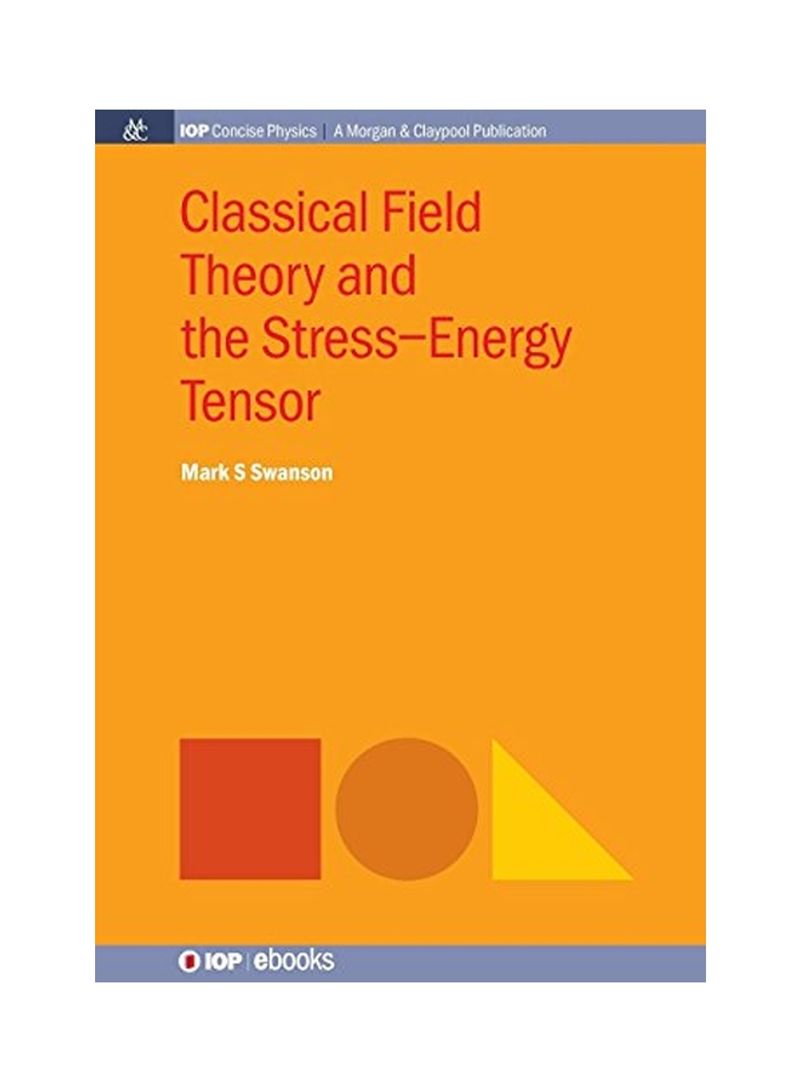


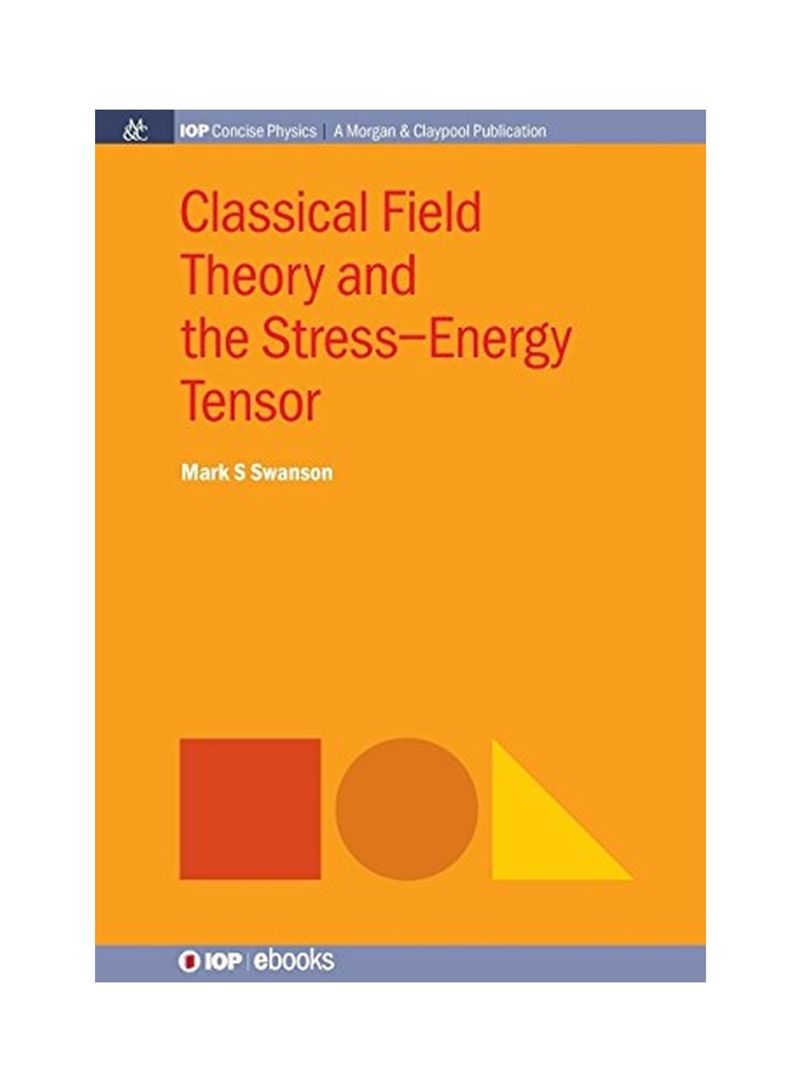
Classical Field Theory And The Stress-energy Tensor Paperback
Recommend
Sort by
Rating
Date
Specifications
Author 1
Mark S. Swanson
Book Description
This book is a concise introduction to the key concepts of classical field theory for beginning graduate students and advanced undergraduate students who wish to study the unifying structures and physical insights provided by classical field theory without dealing with the additional complication of quantization. In that regard, there are many important aspects of field theory that can be understood without quantizing the fields. These include the action formulation, Galilean and relativistic invariance, traveling and standing waves, spin angular momentum, gauge invariance, subsidiary conditions, fluctuations, spinor and vector fields, conservation laws and symmetries, and the Higgs mechanism, all of which are often treated briefly in a course on quantum field theory.It is assumed the reader has a good working knowledge of undergraduate Newtonian mechanics and electricity and magnetism. This includes the Lagrangian formulation of mechanics as an action principle, the formulation of Maxwell's equations in terms of a vector and scalar potential, and a brush with special relativity and its relationship to these two areas. It assumes no background in continuum mechanics and fluid dynamics, spinor fields, general relativity, nonabelian gauge theories, differential geometry, or group theory. The intent is to connect these diverse areas together in terms of variational principles, conservation laws and symmetries, coordinate transformations, and the insights given by the stress-energy tensor.
ISBN-10
1681740575
ISBN-13
9781681740577
Language
English
Publisher
Morgan And Claypool Publishers
Publication Date
12-Oct-15
Number of Pages
187
About the Author
Mark Swanson received his PhD in physics from the University of Missouri at Columbia, USA in 1976. After a post-doctoral appointment at the University of Alberta in Edmonton, he joined the physics department at the University of Connecticut in 1979. His research focused on the relationship between canonical quantization techniques and the functional approach of path integrals, which led to authoring the monograph Path Integrals and Quantum Processes.