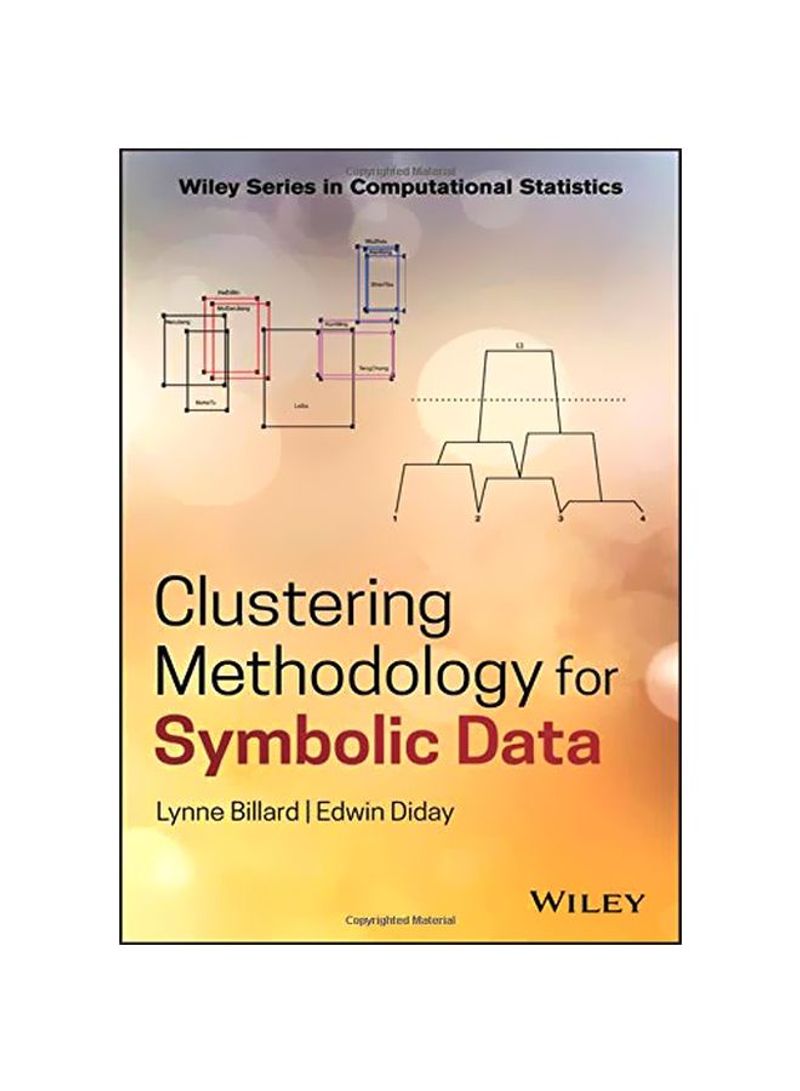


Clustering Methodology For Symbolic Data Hardback
Recommend
Sort by
Rating
Date

Specifications
Author 1
Lynne Billard
Book Description
Symbolic data analysis is a relatively new field that provides a range of methods for analyzing complex datasets. Standard statistical methods do not have the power or flexibility to make sense of very large datasets, and symbolic data analysis techniques have been developed in order to extract knowledge from such a data. Classification Methodology for Symbolic Data: * Provides new classification methodologies for histogram valued data reaching across many fields in data science. * Demonstrates how to manage a large complex dataset into manageable datasets ready for analysis. * Features very large contemporary datasets such as time series, interval-valued data and histogram-valued data * Considers classification models such as dynamical clustering, an extension of K-means, hierarchical pyramidal and Kohonen methodology in detail. * Includes principal components and correspondence analysis methodology. * Features a supporting website hosting relevant software. * Edwin Diday is the founding father of Symbolic Data Analysis. * Extends and expands on the material in Symbolic Data Analysis: Conceptual Statistics and Data Mining, Billard and Diday (2006) Classification Methodology for Symbolic Datais aimed at the practitioners of symbolic data analysis: statisticians and economists within the public (e.g. national statistics institutes) and private (e.g. banks, insurance companies, companies managing databases) sectors. It will also be of interest to postgraduate students of, and researchers within, web mining, text mining and bio-engineering.
ISBN-13
9780470713938
Language
English
Publisher
John Wiley & Sons Inc
Publication Date
2019-11-04
Number of Pages
352
About the Author
LYNNE BILLARD, PHD, is University Professor in the Department of Statistics at the University of Georgia, USA. She has over two hundred and twenty-five publications mostly in leading journals, and co-edited six books. Professor Billard is a former president of ASA, IBS, and ENAR. EDWIN DIDAY, PHD, is the Professor of Computer Science at Centre De Recherche en Mathematiques de la Decision, CEREMADE, Universite Paris-Dauphine, Universite PSL, Paris, France. He has published fifty-eight papers and authored or edited fourteen books. Professor Diday is also the founder of the Symbolic Data Analysis field.
Author 2
Edwin Diday
Format
Hardcover