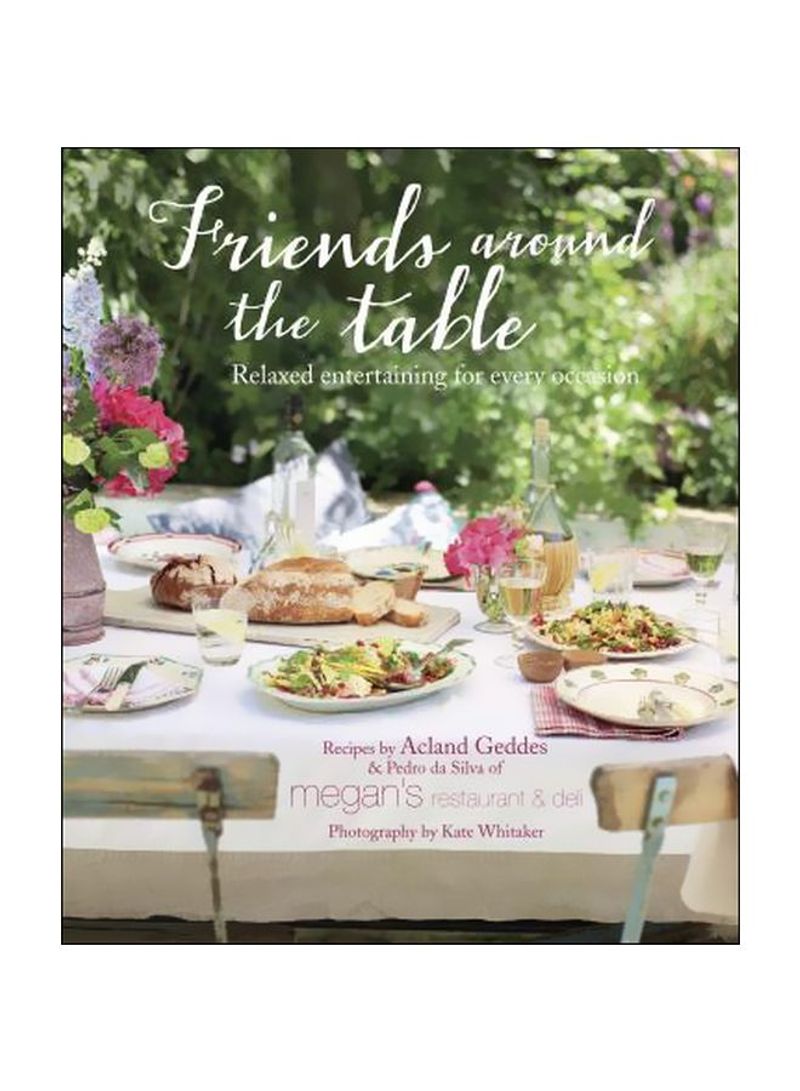


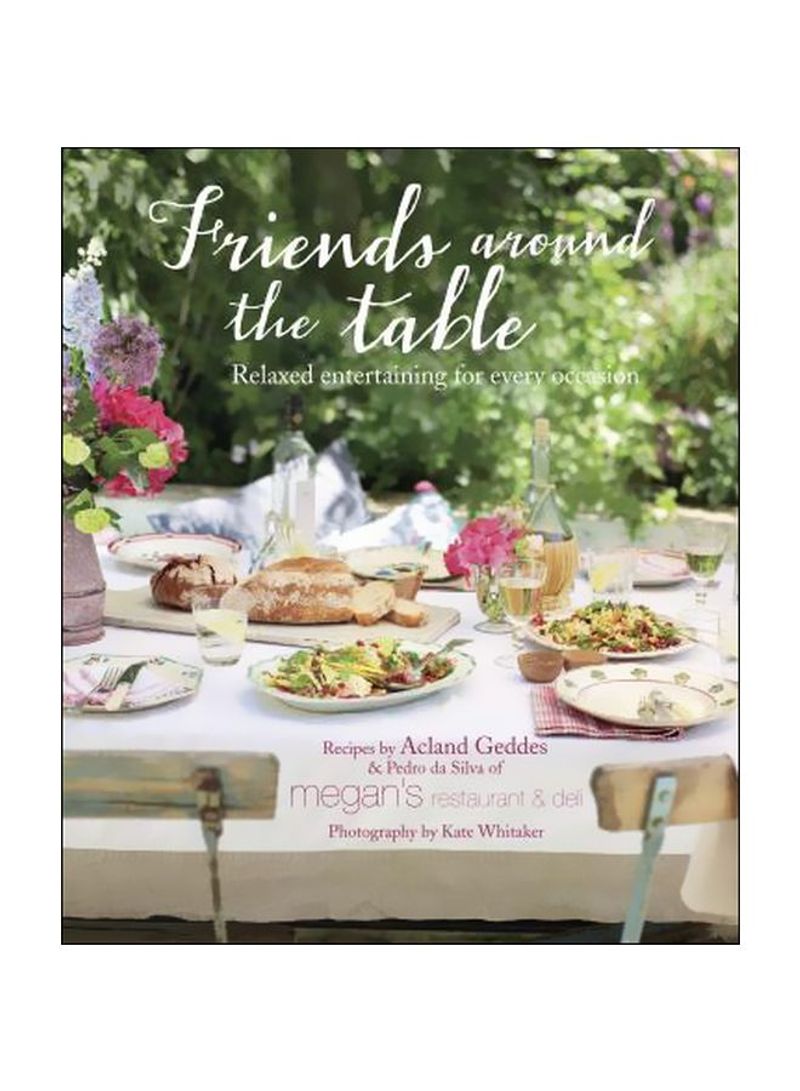
Friends Around The Table: Relaxed Entertaining For Every Occasion Hardcover English by Geddes Acland - 2/1/2014
Recommend
Sort by
Rating
Date
Specifications
Author 1
Geddes Acland
Book Description
Take this magical ambience home with Friends at the Table, the perfect collection of relaxed recipes, whether you're entertaining a group or special someone. Just because you're feeling summery and laid back doesn't mean that your taste buds have gone on holiday. The weather shouldn't be an excuse for throwing any old plate of food together: it should be the reason why you take extra care so the meal can be a memorable one, so try Lunch Al Fresco offerings like grilled squid, chorizo and asparagus salad. Two's Company encourages you to really push the culinary boat out. Dust off those pans, light the candles, snub yet another TV dinner watching Traffic Cops and rustle up an irresistible beef fillet with pea puree and hasselback potatoes! Eating is a communal activity, so in More the Merrier you'll find plenty of ideas for easy sharing plates and small dishes. Finally, catch up with greedy friends and sit down to a banana and chocolate cake or a plate of honey and oat Anzac cookies at Teatime.
ISBN-13
9781849754316
Language
English
Publisher
Ryland, Peters And Small Ltd
Publication Date
2/1/2014
Number of Pages
160
About the Author
Acland Geddes developed a passion for all things edible from a very early age, largely thanks to his mother's homespun Italian cooking. He gave up a spectacularly unsuccessful (not to mention uninspiring) career in advertising to set up a catering service in London. After working as a chef in leading gastropubs in London, he opened the first of two branches of Megan's on the King's Road in Chelsea in 2010.
Editorial Review
What distinguishes this book from the others is that it is targeted at A-level students and their teachers, though International Baccalaureate and foundation year university students would also benefit. These accounts are complemented by an excellent variety of questions. I thoroughly recommend this book to all A-level teachers who wish to challenge their pupils. -- "If you are doing A-level chemistry or perhaps are in the first year of a chemistry degree, the book will be a genuine delight...this is a book that could well make chemistry significantly more approachable and meaningful, making the title very much recommended." -- Brian Clegg * Popular Science * Numerous books on the periodic table have appeared in the last few years, including some singling out particular selections of elements for study (for example Seven elements that have changed the world and A tale of seven elements). What distinguishes this book from the others is that it is targeted at A-level students and their teachers, though International Baccalaureate and foundation year university students would also benefit. The author has chosen 18 elements and examined an extremely extensive range of aspects of their chemistry. He has clearly read widely; for example he is up to date with the growing evidence that links crime with levels of lead (not those from bullets). These accounts are complemented by an excellent variety of questions - often unusual in context - that will test your students' quantitative skills. They cover all sorts of aspects of A-level chemistry, from moles, oxidation numbers and electron configurations, through kinetics and energetics to pH, solubility and electrochemistry. The book features some excellent discussions of some `awkward questions', such as giving a clear account of the reasons behind the unexpectedly large redox potential of lithium. A problem with writing a wide-ranging book like this is that once you get started there is no limit to what you can include. All the same, I would have hoped that the section on lead would include the link between lead levels and IQ: recommending a book like Toxic truth would provide a hat-tip to the pioneering research of Clair Patterson and Herbert Needleman. Similarly, a link between Haber's process for making ammonia and his oversight of Germany's use of poison gases during the first world war would have been good. However, these are very minor criticisms. I thoroughly recommend this book to all A-level teachers who wish to challenge their pupils. -- Simon Cotton This book grabbed me from the beginning. As the book contains many worked problems and examples, it could also be used to advantage by first-year university students, whether majoring in chemistry or in other subjects. The book provides a refreshing look at chemistry from an unusual angle, i.e., by telling-with necessary brevity-stories as to how elements contribute to our complex world. DOI: 10.1002/anie.201407478 -- Andreas Grohmann, Technische Universitat Berlin * Angew. Chem. Int. Ed., 2014, 53, 10857 * I don't think I've ever reviewed a book with such a tightly focussed audience before. If you are doing A-level chemistry or perhaps are in the first year of a chemistry degree (and I say that as someone who did chemistry A-level and the first two years of a chemistry degree), the book will be a genuine delight. But for anyone else it may prove a challenging read. At first sight, what the reader gets is a more detailed equivalent of the Royal Society of Chemistry podcast series Chemistry in its Element, featuring the history, nature, uses and oddities of, in this case, 18 of the elements. There is a lot more here than there is in the podcasts on the actual chemistry of the selected mix of nine metals and nine non-metals - so, for instance, on sulfur we stray into alchemy and the earth's crust, sulfuric acid, sulfates, thiosulfates, organic sulfur and the mysterious hydrothermal vents. Though the text is noticeably heavier on facts than a typical popular science book, this material is put across in a reasonably approachable way. But then, suddenly, the reader comes up against a question that isn't about the material in the book, but rather is testing the reader's readiness for chemistry A-level, for example: Q1. Assign an oxidation number to sulfur in each of the following compounds: SO2, SO3, H2S, (CH3)2S, (CH3)2SO, FeS, FeS2 and CaSO4.2H2O. It might seem that it would be easy enough to skip over the questions, but it really isn't, and as they occur on pretty well every page they take up a significant portion of the book. So, should you fit in that very tight audience (or if you are someone who teaches at this level), this is a book that could well make chemistry significantly more approachable and meaningful, making the title very much recommended. But for the rest of us, it's probably not likely to be a worthwhile addition to your collection. -- Brian Clegg * Popular Science Blog *