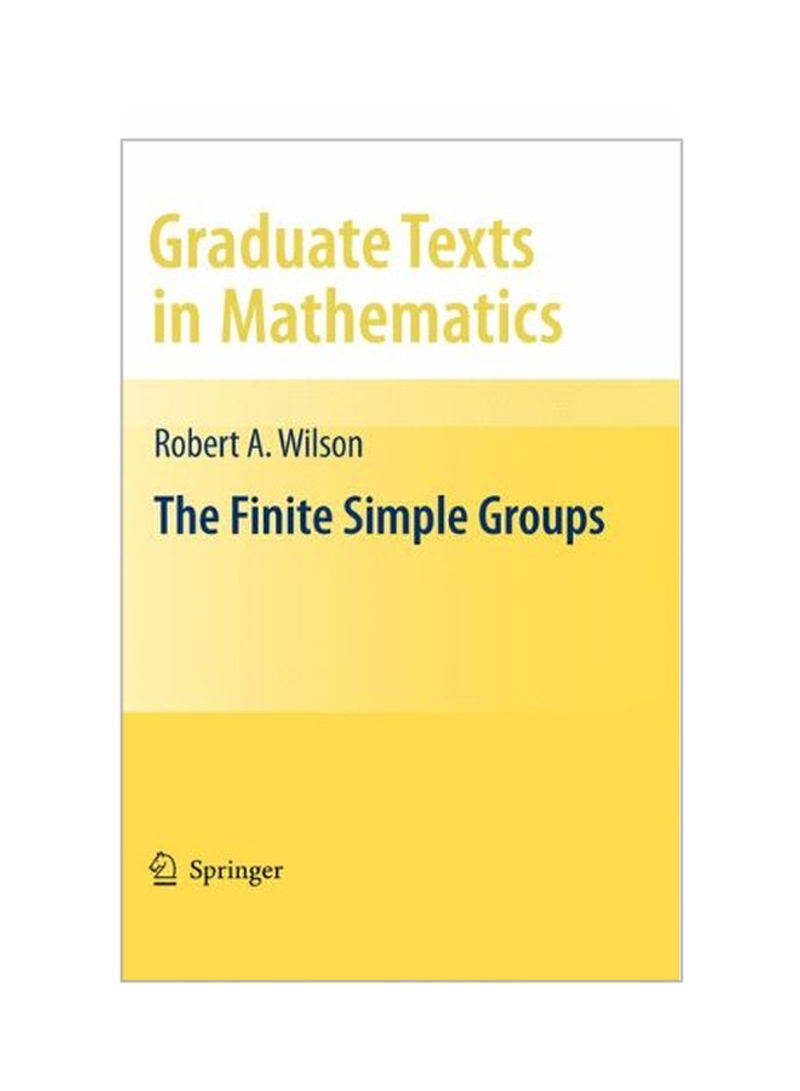


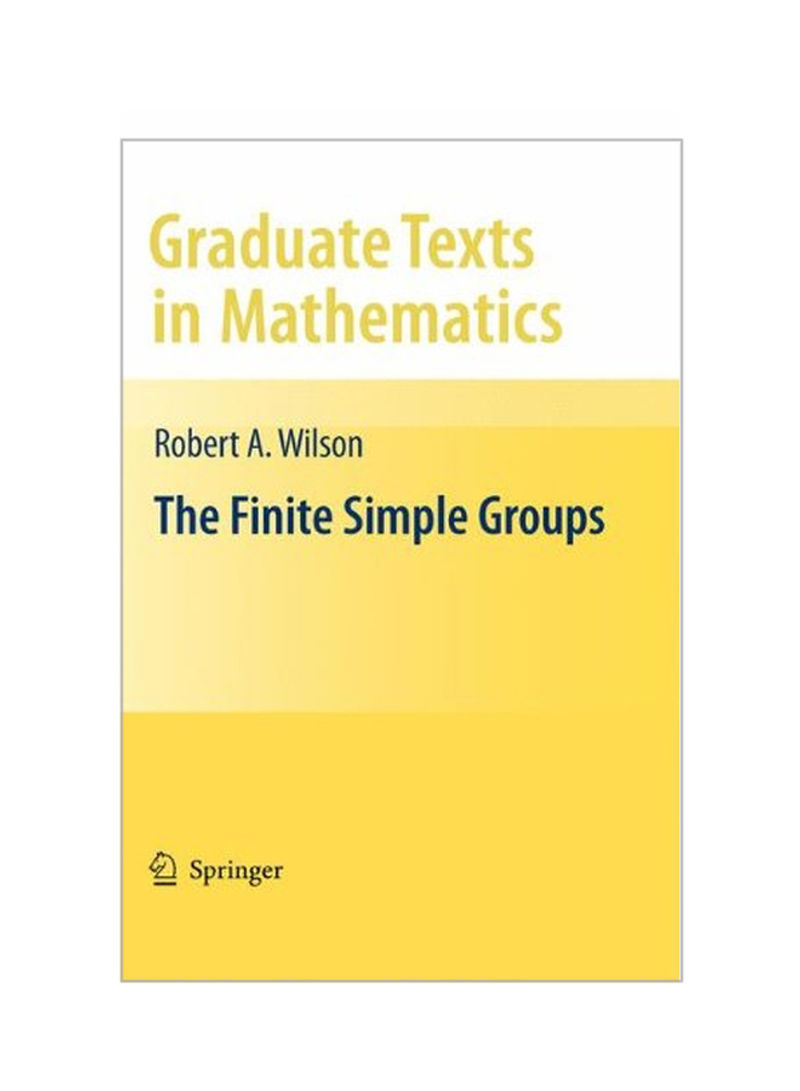
Graduate Texts In Mathematics: The Finite Simple Groups Hardcover
Recommend
Sort by
Rating
Date
Specifications
Author 1
Sir Robert Wilson
Book Description
Thisbookisintendedasanintroductiontoallthe?nitesimplegroups.During themonumentalstruggletoclassifythe?nitesimplegroups(andindeedsince), a huge amount of information about these groups has been accumulated. Conveyingthisinformationtothenextgenerationofstudentsandresearchers, not to mention those who might wish to apply this knowledge, has become a major challenge. With the publication of the two volumes by Aschbacher and Smith [12, 13] in 2004 we can reasonably regard the proof of the Classi?cation Theorem for Finite Simple Groups (usually abbreviated CFSG) as complete. Thus it is timely to attempt an overview of all the (non-abelian) ?nite simple groups in one volume. For expository purposes it is convenient to divide them into four basic types, namely the alternating, classical, exceptional and sporadic groups. The study of alternating groups soon develops into the theory of per- tation groups, which is well served by the classic text of Wielandt [170]and more modern treatments such as the comprehensive introduction by Dixon and Mortimer [53] and more specialised texts such as that of Cameron [19].
ISBN-10
1848009879
ISBN-13
9781848009875
Language
English
Publisher
Springer London Ltd
Publication Date
15 Jan 2010
Number of Pages
298
About the Author
Sheldon Axler is Dean of the College of Science & Engineering at San Francisco State University. He has authored many well-received books.
Author 2
Christopher W. Parker
Editorial Review
The book under review has as its main goal to give an introductory overview of the construction and main properties of all finite simple groups. ... This book is the first one that attempts to give a systematic treatment of all finite simple groups, using the more recent and efficient constructions ... . The author succeeds in making this important but difficult area of mathematics readily accessible to a large sector of the mathematical community, and for this we should be grateful.