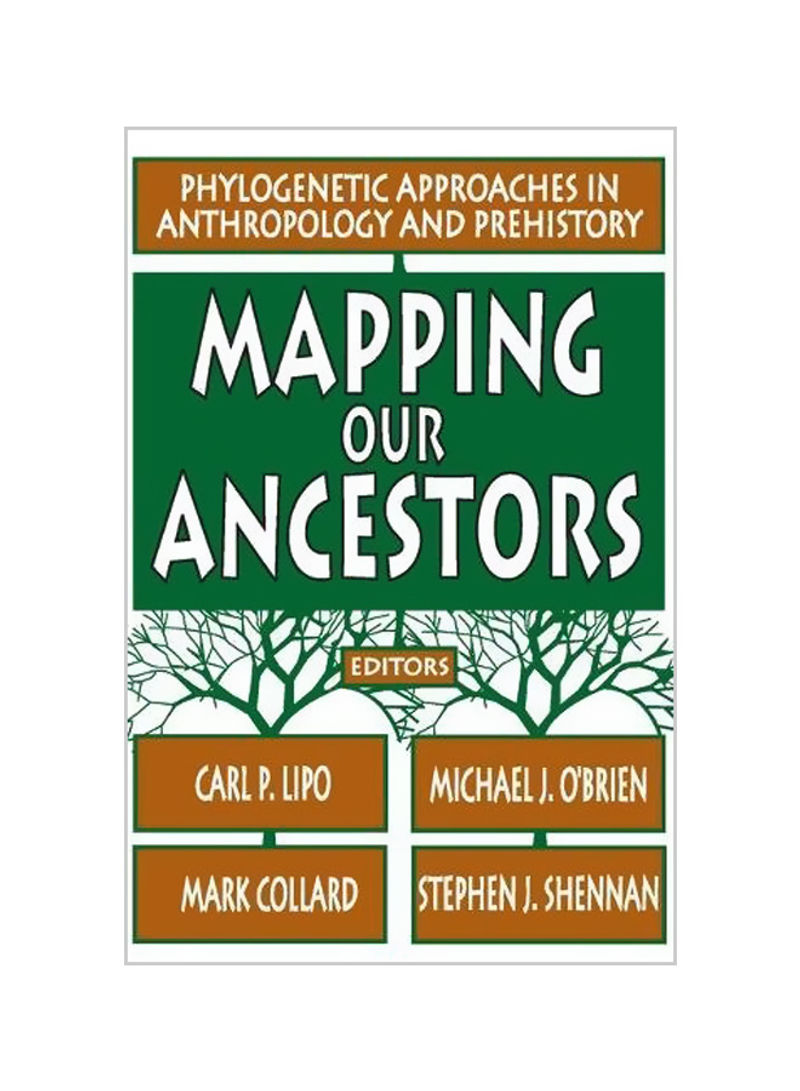


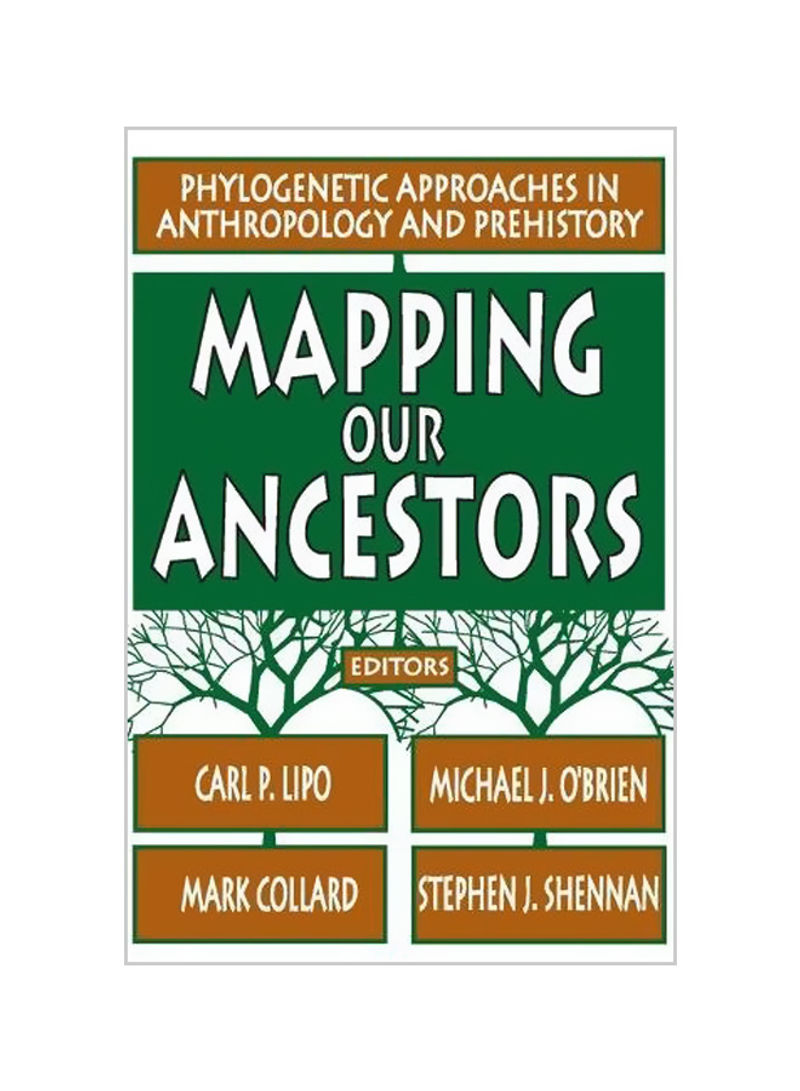
Mapping Our Ancestors: Phylogenetic Approaches In Anthropology And Prehistory Paperback
Recommend
Sort by
Rating
Date
Specifications
Author 1
Carl P. Lipo
Book Description
Much of what we are comes from our ancestors. Through cultural and biological inheritance mechanisms, our genetic composition, instructions for constructing artifacts, the structure and content of languages, and rules for behavior are passed from parents to children and from individual to individual. Mapping Our Ancestors demonstrates how various genealogical or "phylogenetic" methods can be used both to answer questions about human history and to build evolutionary explanations for the shape of history. Anthropologists are increasingly turning to quantitative phylogenetic methods. These methods depend on the transmission of information regardless of mode and as such are applicable to many anthropological questions. In this way, phylogenetic approaches have the potential for building bridges among the various subdisciplines of anthropology; an exciting prospect indeed. The structure of Mapping Our Ancestors reflects the editors' goal of developing a common understanding of the methods and conditions under which ancestral relations can be derived in a range of data classes of interest to anthropologists. Specifically, this volume explores the degree to which patterns of ancestry can be determined from artifactual, genetic, linguistic, and behavioral data and how processes such as selection, transmission, and geography impact the results of phylogenetic analyses. Mapping Our Ancestors provides a solid demonstration of the potential of phylogenetic methods for studying the evolutionary history of human populations using a variety of data sources and thus helps explain how cultural material, language, and biology came to be as they are.
ISBN-13
9780202307510
Language
English
Publisher
Taylor & Francis Inc
Publication Date
30-10-2005
Number of Pages
372
Editor 1
Stephen Shennan
Editor 2
Mark Collard
Editorial Review
-As the various contributors to [Mapping Our Ancestors] make perfectly clear, the application of evolutionary theory to cultural change cannot simply borrow from biological evolution. Cultural transmission is qualitatively different from genetic transmission and requires different concepts and principles, which cannot be borrowed but must be developed by archaeologists, anthropologists, and linguists. Among the differences between cultural and genetic transmission are the presence of horizontal as well as vertical inheritance, the greater propensity for neutral variation, the much higher probability of reticulation (or hybridization), and a more fluid scale at which evolution can occur. While much work remains to be done, the various contributors have made great strides in identifying these problems and suggesting ways they might be resolved. The various articles are not just abstract theorizing but practical attempts to grapple with these issues. After reading this book, how an evolutionary theory of culture might look becomes clearer.---James K. Feathers, Department of Anthropology, University of Washington -These engaging essays help point the way to a new, exciting four-field anthropology, grounded in the use of evolutionary theory and phylogenetic methods to make and evaluate inferences about what happened in human history for archaeological, linguistic, biological, and ethnological data.- --Fraser D. Neiman, Monticello -AS an anthropological method, phylogenetic mapping is still a relatively new method that is in its infancy. Studying this topic has value because it may hold a key to the future of anthropological studies in determining transmission of culture. Phylogenetic mapping is a creative method that allows for a new way to interpret data as well as giving rise to new hypotheses for understanding culture change.....The focus on the relationships of biology, culture change, and knowledge transmission over time and across space are core anthropological concerns impacting every subfield. To understand the complexities of using phylogenetic mapping, one must have a solid four field background. Thus, this highly technical book is most relevant for archaeologists, bioarchaeologists, and historical linguists.- --Maria R. Roti, Anthropology and Aging Quarterly "As the various contributors to [Mapping Our Ancestors] make perfectly clear, the application of evolutionary theory to cultural change cannot simply borrow from biological evolution. Cultural transmission is qualitatively different from genetic transmission and requires different concepts and principles, which cannot be borrowed but must be developed by archaeologists, anthropologists, and linguists. Among the differences between cultural and genetic transmission are the presence of horizontal as well as vertical inheritance, the greater propensity for neutral variation, the much higher probability of reticulation (or hybridization), and a more fluid scale at which evolution can occur. While much work remains to be done, the various contributors have made great strides in identifying these problems and suggesting ways they might be resolved. The various articles are not just abstract theorizing but practical attempts to grapple with these issues. After reading this book, how an evolutionary theory of culture might look becomes clearer."--James K. Feathers, Department of Anthropology, University of Washington "These engaging essays help point the way to a new, exciting four-field anthropology, grounded in the use of evolutionary theory and phylogenetic methods to make and evaluate inferences about what happened in human history for archaeological, linguistic, biological, and ethnological data." --Fraser D. Neiman, Monticello "AS an anthropological method, phylogenetic mapping is still a relatively new method that is in its infancy. Studying this topic has value because it may hold a key to the future of anthropological studies in determining transmission of culture. Phylogenetic mapping is a creative method that allows for a new way to interpret data as well as giving rise to new hypotheses for understanding culture change.....The focus on the relationships of biology, culture change, and knowledge transmission over time and across space are core anthropological concerns impacting every subfield. To understand the complexities of using phylogenetic mapping, one must have a solid four field background. Thus, this highly technical book is most relevant for archaeologists, bioarchaeologists, and historical linguists." --Maria R. Roti, Anthropology and Aging Quarterly "As the various contributors to ["Mapping Our Ancestors"] make perfectly clear, the application of evolutionary theory to cultural change cannot simply borrow from biological evolution. Cultural transmission is qualitatively different from genetic transmission and requires different concepts and principles, which cannot be borrowed but must be developed by archaeologists, anthropologists, and linguists. Among the differences between cultural and genetic transmission are the presence of horizontal as well as vertical inheritance, the greater propensity for neutral variation, the much higher probability of reticulation (or hybridization), and a more fluid scale at which evolution can occur. While much work remains to be done, the various contributors have made great strides in identifying these problems and suggesting ways they might be resolved. The various articles are not just abstract theorizing but practical attempts to grapple with these issues. After reading this book, how an evolutionary theory of culture might look becomes clearer."--James K. Feathers, Department of Anthropology, University of Washington "These engaging essays help point the way to a new, exciting four-field anthropology, grounded in the use of evolutionary theory and phylogenetic methods to make and evaluate inferences about what happened in human history for archaeological, linguistic, biological, and ethnological data." --Fraser D. Neiman, Monticello "AS an anthropological method, phylogenetic mapping is still a relatively new method that is in its infancy. Studying this topic has value because it may hold a key to the future of anthropological studies in determining transmission of culture. Phylogenetic mapping is a creative method that allows for a new way to interpret data as well as giving rise to new hypotheses for understanding culture change.....The focus on the relationships of biology, culture change, and knowledge transmission over time and across space are core anthropological concerns impacting every subfield. To understand the complexities of using phylogenetic mapping, one must have a solid four field background. Thus, this highly technical book is most relevant for archaeologists, bioarchaeologists, and historical linguists." --Maria R. Roti, Anthropology and Aging Quarterly
Editor 3
Carl P. Lipo