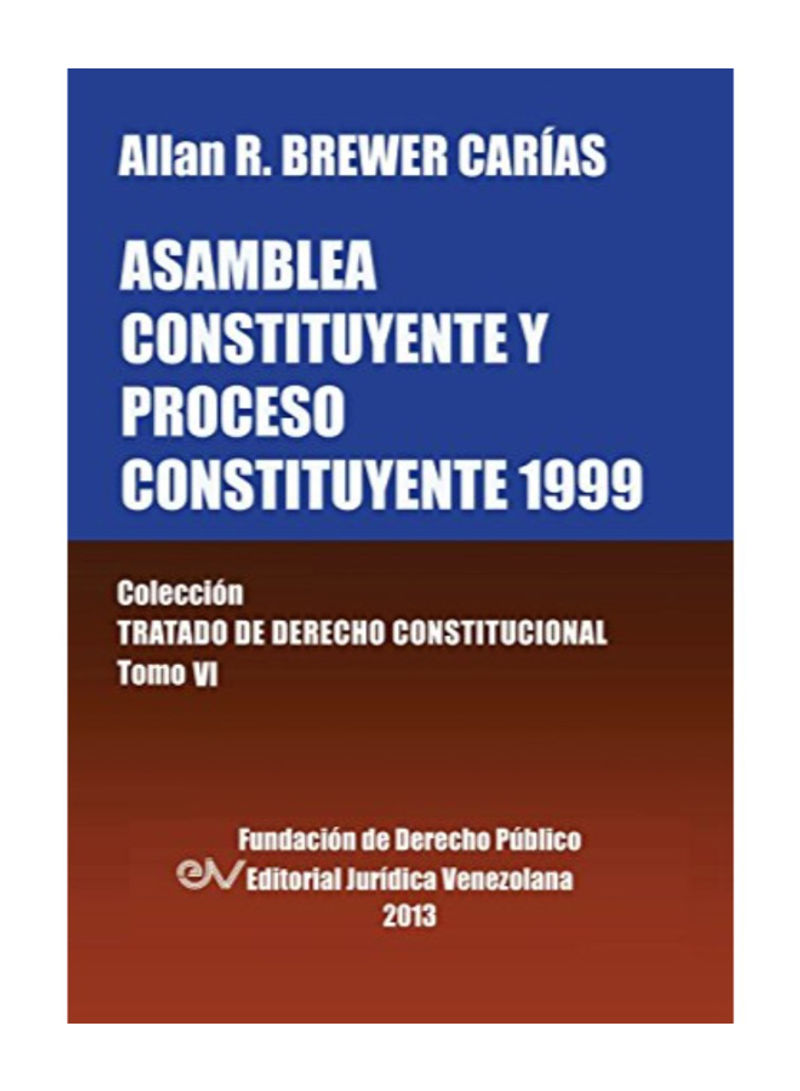


Asamblea Constituyente y Proceso Constituyente 1999 Paperback
Recommend
Sort by
Rating
Date
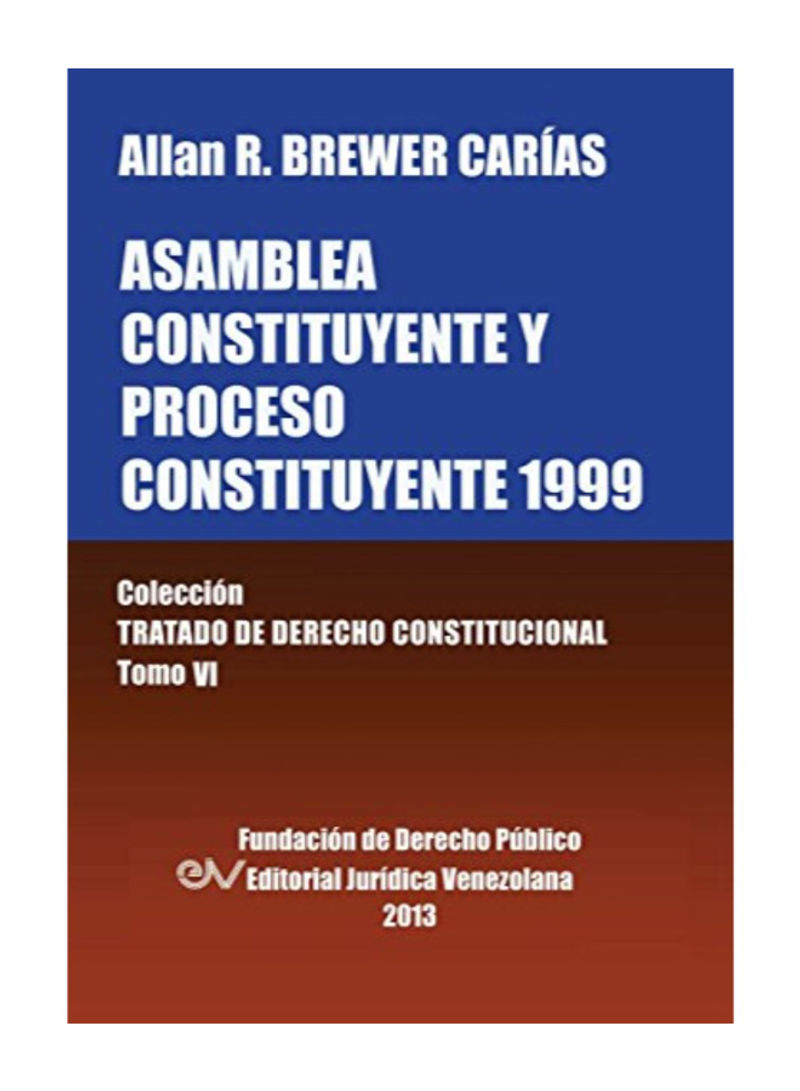
Specifications
Author 1
Allan R. Brewer-Carias
Book Description
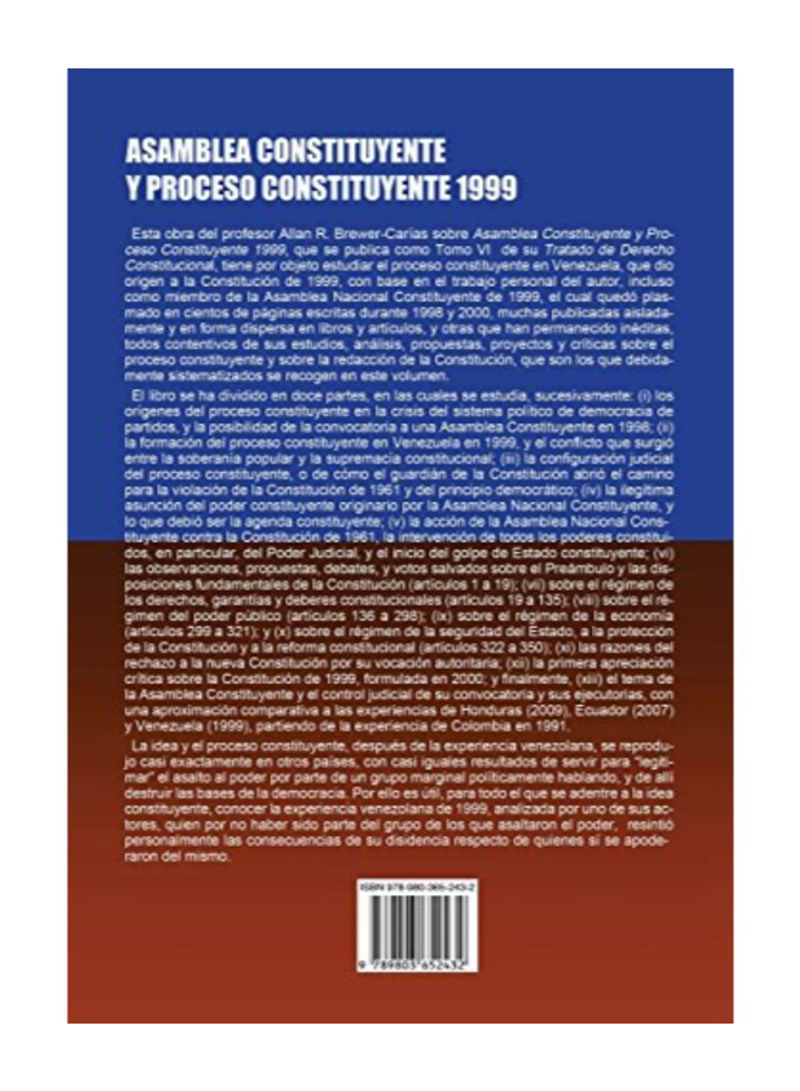
This work by Professor Allan R. Brewer-Carías on Constituent Assembly and Constitutional Process 1999, which is published as Volume VI of its Constitutional Law Treaty, aims to study the constituent process in Venezuela, which gave birth to the 1999 Constitution, based on the personal work of the author, including as a member of the National Constituent Assembly of 1999, which was reflected in hundreds of pages written during 1998 and 2000, many published separately and in scattered form in books and articles, and others that have remained unpublished, all content of their studies, analyzes, proposals, projects and criticisms of the constituent process and the drafting of the Constitution, which are duly systematized in this volume. The book has been divided into twelve parts, in which it is studied, successively: (i) the origins of the constituent process in the crisis of the political system of party democracy, and the possibility of convening a Constituent Assembly in 1998; (ii) the formation of the constituent process in Venezuela in 1999, and the conflict that arose between popular sovereignty and constitutional supremacy; (iii) the judicial configuration of the constituent process, or how the guardian of the Constitution opened the way for the violation of the 1961 Constitution and the democratic principle; (iv) the illegitimate assumption of the original constituent power by the National Constituent Assembly, and what should have been the constituent agenda; (v) the action of the National Constituent Assembly against the Constitution of 1961, the intervention of all constituted powers, in particular, of the Judicial Power, and the beginning of the constituent coup d'état; (vi) the observations, proposals, debates, and votes saved on the Preamble and the fundamental provisions of the Constitution (articles 1 to 19); (vii) on the regime of rights, guarantees and constitutional duties (articles 19 to 135); (viii) on the regime of public power (articles 136 to 298); (ix) on the regime of the economy (articles 299 to 321); and (x) on the regime of State security, the protection of the Constitution and the constitutional reform (articles 322 to 350); (xi) the reasons for the rejection of the new Constitution because of its authoritarian vocation; (xii) the first critical assessment of the 1999 Constitution, formulated in 2000; and finally, (xiii) the theme of the Constituent Assembly and the judicial control of its convocation and its executions, with a comparative approach to the experiences of Honduras (2009), Ecuador (2007) and Venezuela (1999), based on the experience of Colombia in 1991. The idea and the constituent process, after the Venezuelan experience, was reproduced almost exactly in other countries, with almost equal results of serving to "legitimize" the assault on power by a marginal group politically speaking, and from there destroy the foundations of democracy. For this reason, it is useful, for all who enter the constituent idea, to know the Venezuelan experience of 1999, analyzed by one of its actors, who because they were not part of the group of those who assaulted power,
ISBN-13
9789803652432
Language
Spanish
Publisher
Fundacion Editorial Juridica Venezolana