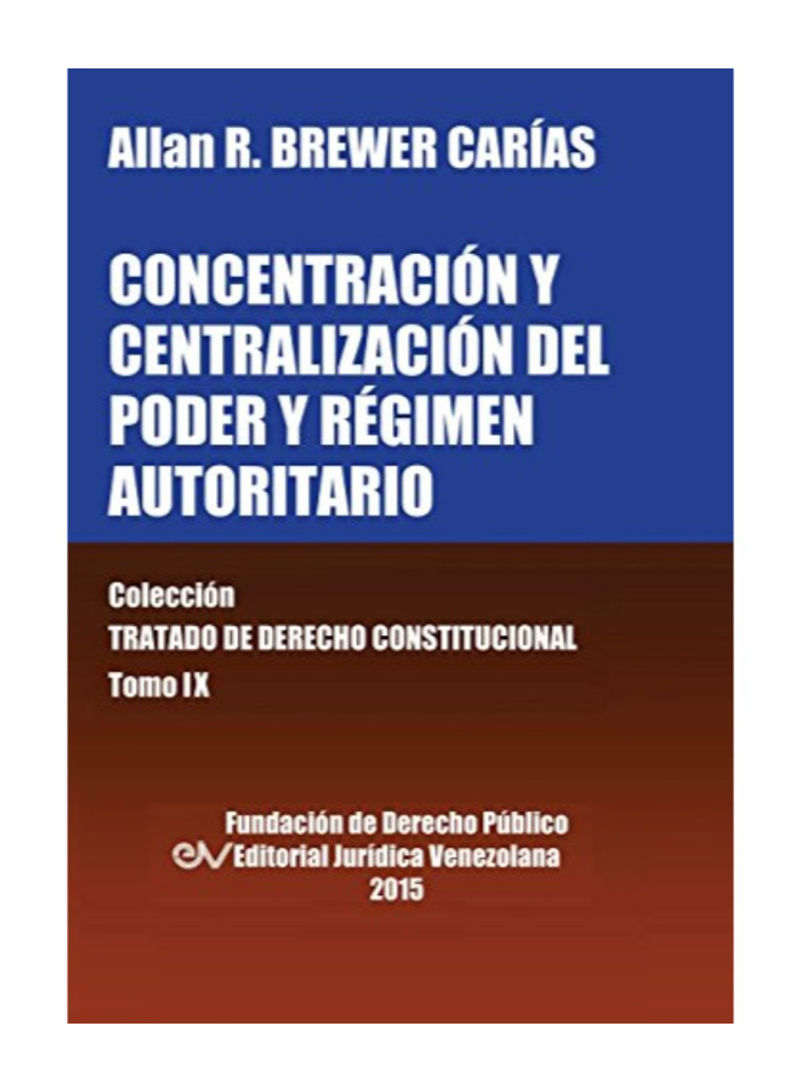


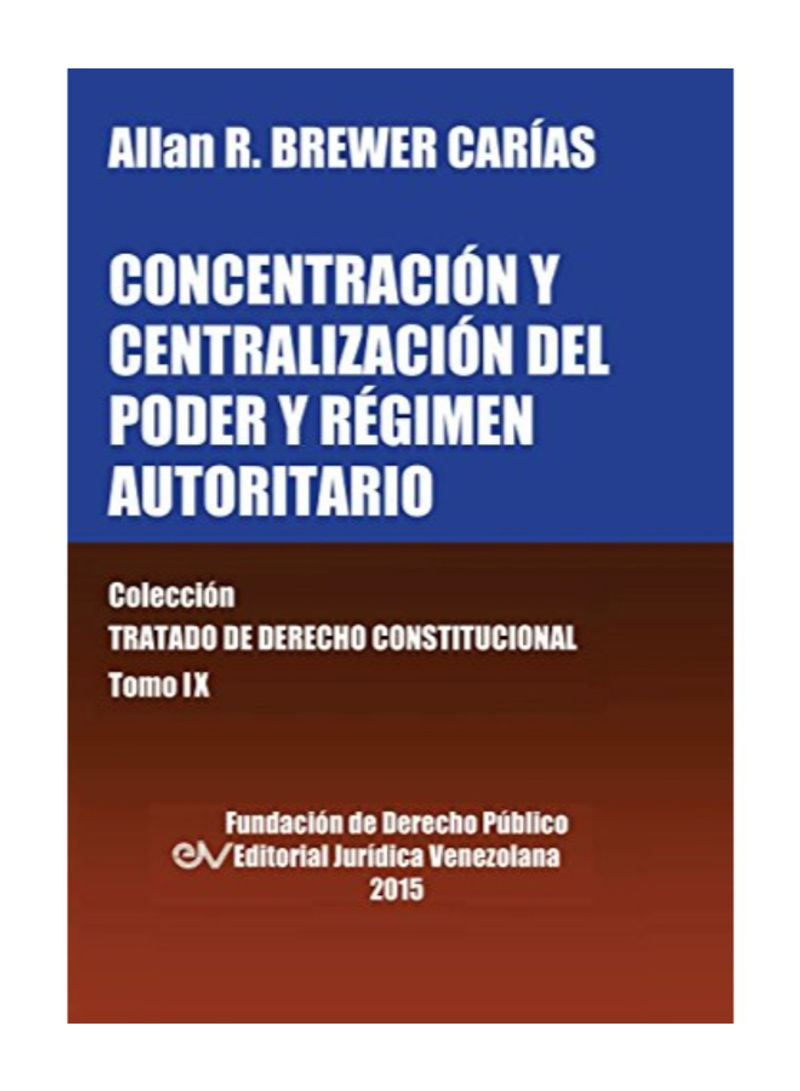
Concentracion y Centralizacion del Poder y Regimen Autoritario Paperback
Recommend
Sort by
Rating
Date
Specifications
Author 1
Allan R. Brewer-Carias
Book Description
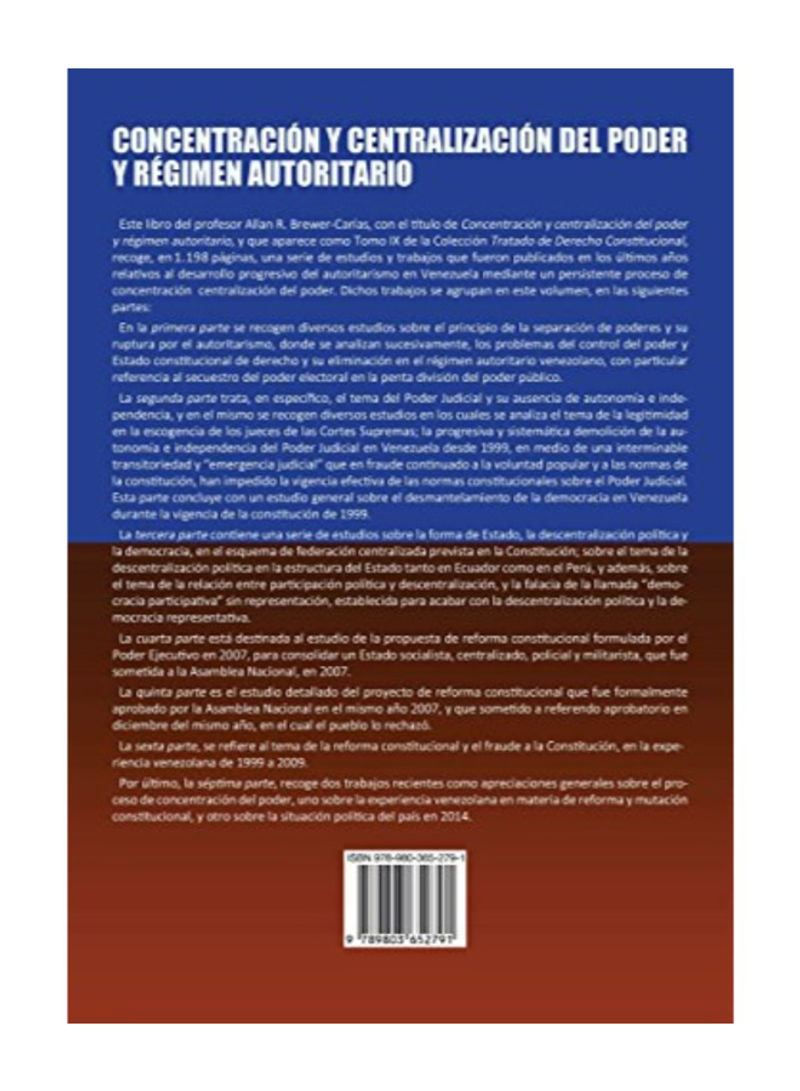
This book by Professor Allan R. Brewer-Carías, with the title of Concentration and centralization of power and authoritarian regime, and which appears as Volume IX of its Constitutional Law Treaty Collection, contains, in 1,200 pages, a series of studies and works published in recent years regarding the progressive development of authoritarianism in Venezuela, through a persistent process of concentration and centralization of power. These works are grouped in this volume, in the following parts: In the first part several studies are collected on the principle of the separation of powers and their rupture by the authoritarian regime, which analyzes, successively, the problems of power control and Constitutional state of law, and its elimination in the Venezuelan authoritarian regime, with particular reference to the kidnapping of the electoral power in the penta division of public power. The second part deals, specifically, with the issue of the Judiciary and the absence of its autonomy and independence, and it includes various studies in which the issues of legitimacy in the choice of judges of the courts are analyzed Supreme; and the gradual and systematic demolition of the autonomy and independence of the Judiciary in Venezuela since 1999, in the midst of an interminable transience and "judicial emergency" that in fraud continued to the popular will and the rules of the Constitution, has impeded the validity effective of the constitutional norms on the Judicial Power. This Part concludes with a general study on the dismantling of democracy in Venezuela during the validity of the 1999 Constitution. The third part contains a series of studies on the form of State, political decentralization and democracy, in the federation scheme centralized provision in the Constitution; on the issue of political decentralization in the structure of the State both in Ecuador and in Peru, and also on the issue of the relationship between political participation and decentralization, and the fallacy of the so-called "participatory democracy" without representation, established for end political decentralization and representative democracy. The fourth part is devoted to the study of the constitutional reform proposal formulated by the Executive Power in 2007, to consolidate a socialist, centralized, police and militarist state, which was submitted to the National Assembly in 2007. The fifth part is the detailed study of the constitutional reform project that was formally approved by the National Assembly in the same year 2007, and that submitted to referendum in December of the same year, was rejected by the people. The sixth part refers to the topic of constitutional reform and constitutional fraud, in the Venezuelan experience from 1999 to 2009 Finally, the seventh part includes two works formulated as general assessments on the process of concentration of power, one on the Venezuelan experience in constitutional reform and mutation, and another on the country's political situation in 2014. that was submitted to the National Assembly, in 2007. The fifth part is the detailed study of the constitutional reform project that was formally approved by the National Assembly in the same year 2007, and which, subject to an approval referendum in December of the same year, was rejected by the people. The sixth part refers to the topic of constitutional reform and constitutional fraud, in the Venezuelan experience from 1999 to 2009 Finally, the seventh part includes two works formulated as general assessments on the process of concentration of power, one on the Venezuelan experience in constitutional reform and mutation, and another on the country's political situation in 2014. that was submitted to the National Assembly, in 2007. The fifth part is the detailed study of the constitutional reform project that was formally approved by the National Assembly in the same year 2007, and which, subject to an approval referendum in December of the same year, was rejected by the people. The sixth part refers to the topic of constitutional reform and constitutional fraud, in the Venezuelan experience from 1999 to 2009 Finally, the seventh part includes two works formulated as general assessments on the process of concentration of power, one on the Venezuelan experience in constitutional reform and mutation, and another on the country's political situation in 2014. The fifth part is the detailed study of the project of constitutional reform that was formally approved by the National Assembly in the same year 2007, and that submitted to referendum in December of the same year, was rejected by the people. The sixth part refers to the topic of constitutional reform and constitutional fraud, in the Venezuelan experience from 1999 to 2009 Finally, the seventh part includes two works formulated as general assessments on the process of concentration of power, one on the Venezuelan experience in constitutional reform and mutation, and another on the country's political situation in 2014. The fifth part is the detailed study of the project of constitutional reform that was formally approved by the National Assembly in the same year 2007, and that submitted to referendum in December of the same year, was rejected by the people. The sixth part refers to the topic of constitutional reform and constitutional fraud, in the Venezuelan experience from 1999 to 2009 Finally, the seventh part includes two works formulated as general assessments on the process of concentration of power, one on the Venezuelan experience in constitutional reform and mutation, and another on the country's political situation in 2014.
ISBN-13
9789803652791
Language
Spanish
Publisher
Fundacion Editorial Juridica Venezolana