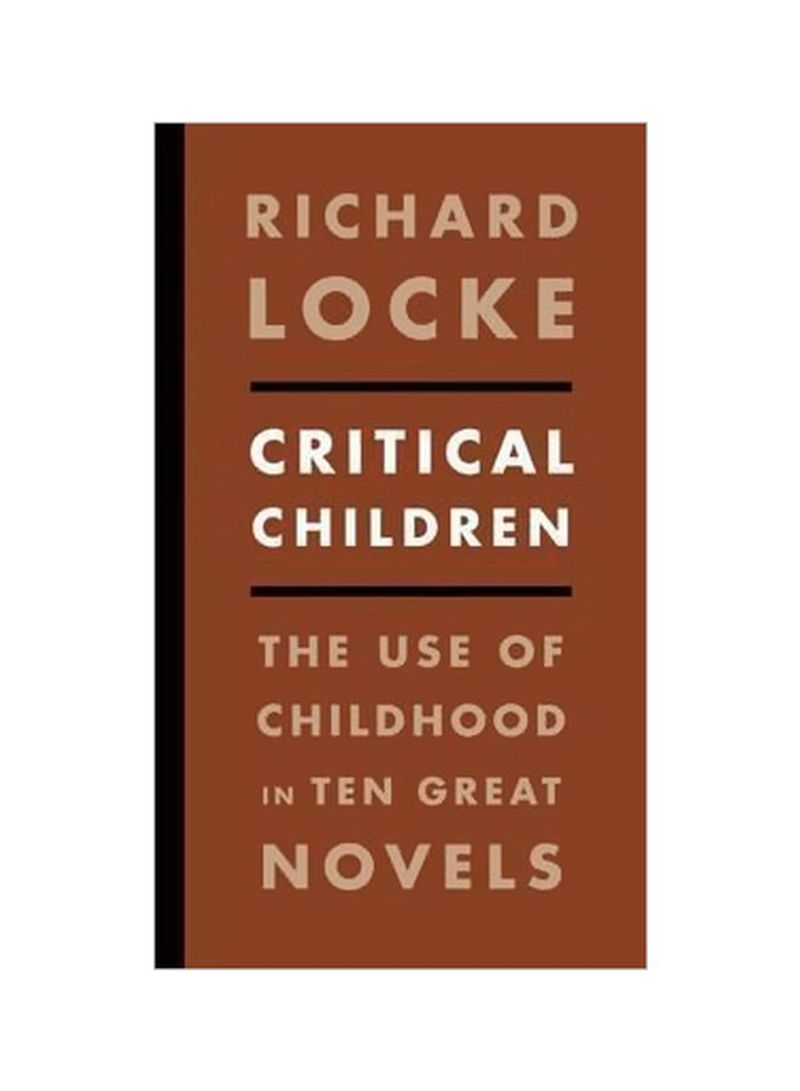


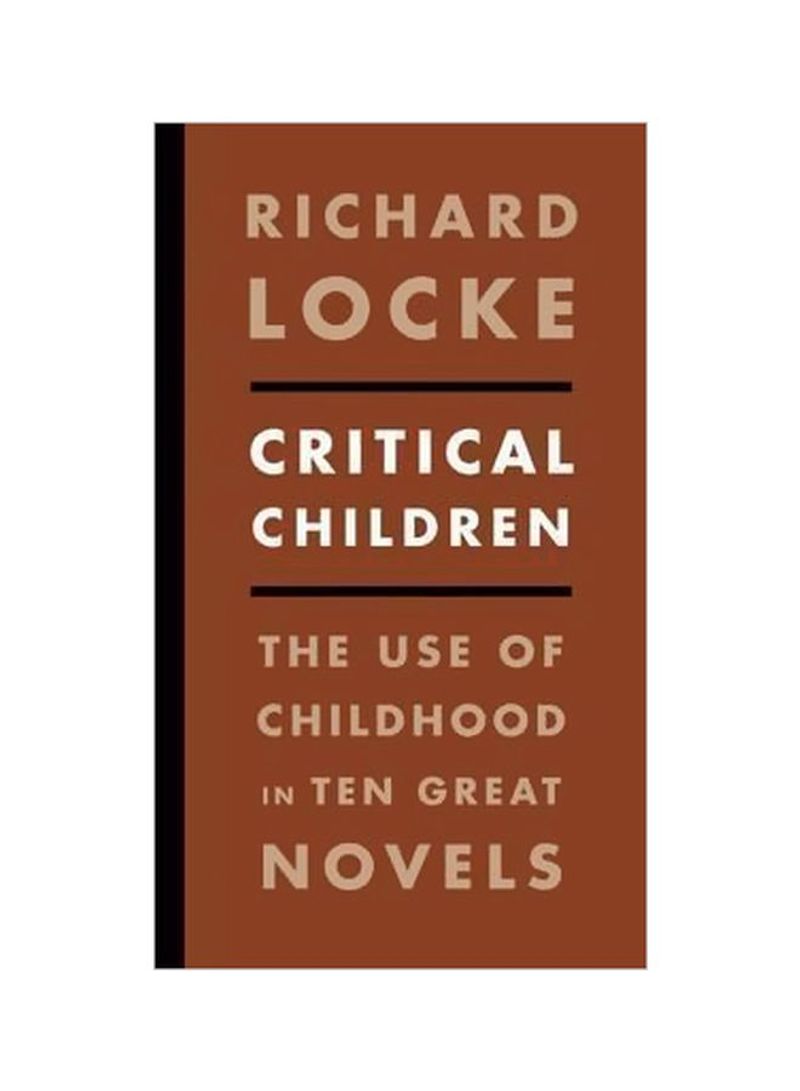
Critical Children: The Use Of Childhood In Ten Great Novels Paperback
Recommend
Sort by
Rating
Date
Specifications
Author 1
Richard Locke
Book Description
The ten novels explored in Critical Children portray children so vividly that their names are instantly recognizable. Richard Locke traces the 130-year evolution of these iconic child characters, moving from Oliver Twist, David Copperfield, and Pip in Great Expectations to Tom Sawyer and Huckleberry Finn; from Miles and Flora in The Turn of the Screw to Peter Pan and his modern American descendant, Holden Caulfield; and finally to Lolita and Alexander Portnoy. "It's remarkable," writes Locke, "that so many classic (or, let's say, unforgotten) English and American novels should focus on children and adolescents not as colorful minor characters but as the intense center of attention." Despite many differences of style, setting, and structure, they all enlist a particular child's story in a larger cultural narrative. In Critical Children, Locke describes the ways the children in these novels have been used to explore and evade large social, psychological, and moral problems. Writing as an editor, teacher, critic, and essayist, Locke demonstrates the way these great novels work, how they spring to life from their details, and how they both invite and resist interpretation and provoke rereading. Locke conveys the variety and continued vitality of these books as they shift from Victorian moral allegory to New York comic psychoanalytic monologue, from a child who is an agent of redemption to one who is a narcissistic prisoner of guilt and proud rage.
ISBN-13
9780231157834
Language
English
Publisher
Columbia University Press
Publication Date
8/2/2013
Number of Pages
232
About the Author
Richard Locke is professor of writing at the Columbia University School of the Arts, and his essays and reviews have appeared in the New York Times Book Review, the Wall Street Journal, The American Scholar, The Threepenny Review, The Yale Review, and other publications. He has been editor in chief of Vanity Fair and deputy editor of the New York Times Book Review.
Editorial Review
A striking portrait of the emergence of Cold War science. The book contributes to a growing historical literature that has begun to reconfigure our understanding of the period and its enduring legacies. . . . Creager's deft attention to the ironies that have accompanied efforts to harness the atom is history of science at its best: a crystal clear portrait of just how untidy the impacts of science can be.--Joanna Radin "Science " "A landmark achievement. . . . Well researched and masterfully narrated, Life Atomic is a must-read book for anyone who is interested in the instrument-driven development of life sciences following the WWII."--Paul J. J. M. Bakker, Radboud University Nijmegen, The Netherlands. "Journal of the History of Medicine " A striking portrait of the emergence of Cold War science. The book contributes to a growing historical literature that has begun to reconfigure our understanding of the period and its enduring legacies. . . . Creager s deft attention to the ironies that have accompanied efforts to harness the atom is history of science at its best: a crystal clear portrait of just how untidy the impacts of science can be. --Joanna Radin "Science "" "Angela N. H. Creager's book is breathtaking in scope, a lucid, original account of how radioisotopes came to suffuse and, in many ways, transform research in fields ranging from the experimental life sciences to biomedicine and ecology. It evenhandedly reveals the close coupling between their exploitation and the dynamics of the Cold War, illuminating how they served at once the purposes of health and security, pressing against the ethical boundaries of research with human subjects while helping to tie together the laboratory and the clinic. In all, a masterful work of historical scholarship." --Daniel J. Kevles, Yale University "Life Atomic is the first comprehensive history of radioactive tracing, a key research technology without which a science such as molecular biology would not have come into being. Through this technology, the life sciences and medicine came into deep resonance with the atomic Cold War era. Angela N. H. Creager beautifully unfolds this web before our eyes, and does so by making use of a rich variety of archival sources." --Hans-Jorg Rheinberger, Max Planck Institute for the History of Science "A fascinating portrait of the use and meaning of radioisotopes in twentieth-century science and medicine, Angela N. H. Creager's Life Atomic is serious, high-quality scholarship that contributes to our understanding of science over the last century. This long-awaited volume justifies the wait." --M. Susan Lindee, University of Pennsylvania "Exhaustively documented and sharply written, with no place for anecdote, Life Atomic provides a coherent narrative about the industrialisation, regulation, and scientific and medical impact of radioisotopes in the United States during the Cold War."--Nestor Herran, Universite Pierre et Marie Curie, Paris "AMBIX " "Radioisotopes are a cornerstone of technology, facilitating basic research and augmenting medical treatment. As a biochemist familiar with such isotopes, decorated historian Creager is well qualified to examine the expansion of radioactive power. Her Life Atomic is a strikingly complete narrative of the social and scientific factors sparking such expansion in the peaceful realm. . . . Students and seasoned professionals alike will gain significant insight into the foundations of this central technology, making it a critical resource for academic and professional libraries. Essential."--B. D. Spiegelberg, Rider University "Choice " "Angela Creager's deeply researched and elegantly written new book is a must-read account of the history of science in twentieth-century America. . . . Not only is it a historiographically important and meticulously crafted work based on exhaustive research, but it's also a great set of stories. The pages of Life Atomic are full of guinea pigs, scientific vaudeville, and stories and characters from many different fields of the modern life sciences, expertly weaving them together into a compelling set of arguments."--Carla Nappi "New Books in Science, Technology, and Society " Angela N. H. Creager s book is breathtaking in scope, a lucid, original account of how radioisotopes came to suffuse and, in many ways, transform research in fields ranging from the experimental life sciences to biomedicine and ecology. It evenhandedly reveals the close coupling between their exploitation and the dynamics of the Cold War, illuminating how they served at once the purposes of health and security, pressing against the ethical boundaries of research with human subjects while helping to tie together the laboratory and the clinic. In all, a masterful work of historical scholarship. --Daniel J. Kevles, Yale University" Life Atomic is the first comprehensive history of radioactive tracing, a key research technology without which a science such as molecular biology would not have come into being. Through this technology, the life sciences and medicine came into deep resonance with the atomic Cold War era. Angela N. H. Creager beautifully unfolds this web before our eyes, and does so by making use of a rich variety of archival sources. --Hans-Jorg Rheinberger, Max Planck Institute for the History of Science" A fascinating portrait of the use and meaning of radioisotopes in twentieth-century science and medicine, Angela N. H. Creager s Life Atomic is serious, high-quality scholarship that contributes to our understanding of science over the last century. This long-awaited volume justifies the wait. --M. Susan Lindee, University of Pennsylvania" Radioisotopes are a cornerstone of technology, facilitating basic research and augmenting medical treatment. As a biochemist familiar with such isotopes, decorated historian Creager is well qualified to examine the expansion of radioactive power. Her Life Atomic is a strikingly complete narrative of the social and scientific factors sparking such expansion in the peaceful realm. . . . Students and seasoned professionals alike will gain significant insight into the foundations of this central technology, making it a critical resource for academic and professional libraries. Essential. --B. D. Spiegelberg, Rider University "Choice "" "A thorough and fascinating account of the challenges that the US Atomic Energy Commission faced in the course of trying to remake nuclear radiation into a scientific and medical tool, as well as a profitable product. . . . Life Atomic is an enjoyable and important book, which should top the reading list of any scholar interested in the development of postwar science and medicine."--Andrew J. Hogan "Metascience " Angela Creager s deeply researched and elegantly written new book is a must-read account of the history of science in twentieth-century America. . . . Not only is it a historiographically important and meticulously crafted work based on exhaustive research, but it s also a great set of stories. The pages of Life Atomic are full of guinea pigs, scientific vaudeville, and stories and characters from many different fields of the modern life sciences, expertly weaving them together into a compelling set of arguments. --Carla Nappi "New Books in Science, Technology, and Society "" "Novel and engaging. . . . With its dedication to tracing the diverse, recent, and now mostly forgotten trajectories of radioisotopes in American biomedicine, Life Atomic abounds with historicist insights."--Kenton Kroker "Isis " "Life Atomic" is the first comprehensive history of radioactive tracing, a key research technology without which a science such as molecular biology would not have come into being. Through this technology, the life sciences and medicine came into deep resonance with the atomic Cold War era. Angela N. H. Creager beautifully unfolds this web before our eyes, and does so by making use of a rich variety of archival sources. --Hans-Jorg Rheinberger, Max Planck Institute for the History of Science" ""Life Atomic" is the first comprehensive history of radioactive tracing, a key research technology without which a science such as molecular biology would not have come into being. Through this technology, the life sciences and medicine came into deep resonance with the atomic Cold War era. Angela N. H. Creager beautifully unfolds this web before our eyes, and does so by making use of a rich variety of archival sources." --Hans-Jorg Rheinberger, Max Planck Institute for the History of Science"