


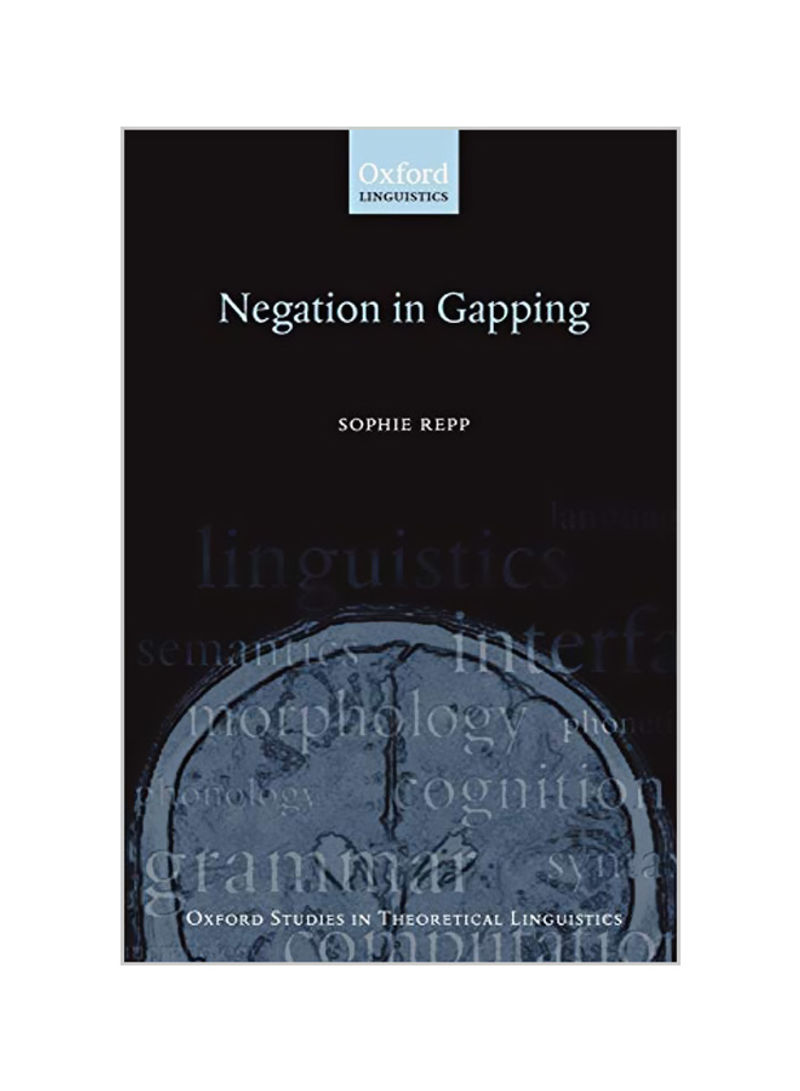
Negation In Gapping Paperback
Recommend
Sort by
Rating
Date

Specifications
Author 1
Sophie Repp
Book Description
This book presents a cross-linguistic investigation of the behaviour of negation in gapping sentences. Sophie Repp focusses on German and English with reference to Dutch, Japanese, Polish, Russian, and Slovak. She shows that these languages exhibit important differences in the interaction of gapping and negation and further that no account in the literature explains why this should be. Dr Repp also argues that the precise interpretation of an elided negation depends on varying combinations of syntactic, semantic, pragmatic, and prosodic factors. Illustrating her argument by the interpretation of the negation in examples such as "Pete hasn't got a video and John a DVD", "Pete didn't clean the whole flat and John laze around all afternoon", and "To Mary, Pete didn't say anything and to Sue, only that he was hungry", Dr Repp questions a basic assumption in the analysis of gapping: that the meaning of the two conjuncts must be parallel in the elided material. This leads her to a wide-ranging discussion of the interpretation of scope and the nature of negation. She then proposes a syntactic analysis that both takes into account the interaction of the grammatical interfaces and is at the same time compatible with more general assumptions of current generative theory. She concludes by considering the implications of her findings for linguistic theory more generally.
ISBN-13
9780199543618
Language
English
Publisher
Oxford University Press
Publication Date
15-02-2009
Number of Pages
282
About the Author
Sophie Repp is a Research Associate in Linguistics at the Humboldt University Berlin.
Editorial Review
Negation in Gapping is a challenging book written on challenging topics by a researcher who is committed to and talented in combining a wide range of empirical facts with highly sophisticated theorizing ... the book righly rewards those who are well informed in the ellipsis literature and are open to interdisciplinary analyses. * Satoshi Tomioka, Language *