


The Future Of Social Work Hardcover
Recommend
Sort by
Rating
Date


Specifications
Author 1
Brij Mohan
Book Description
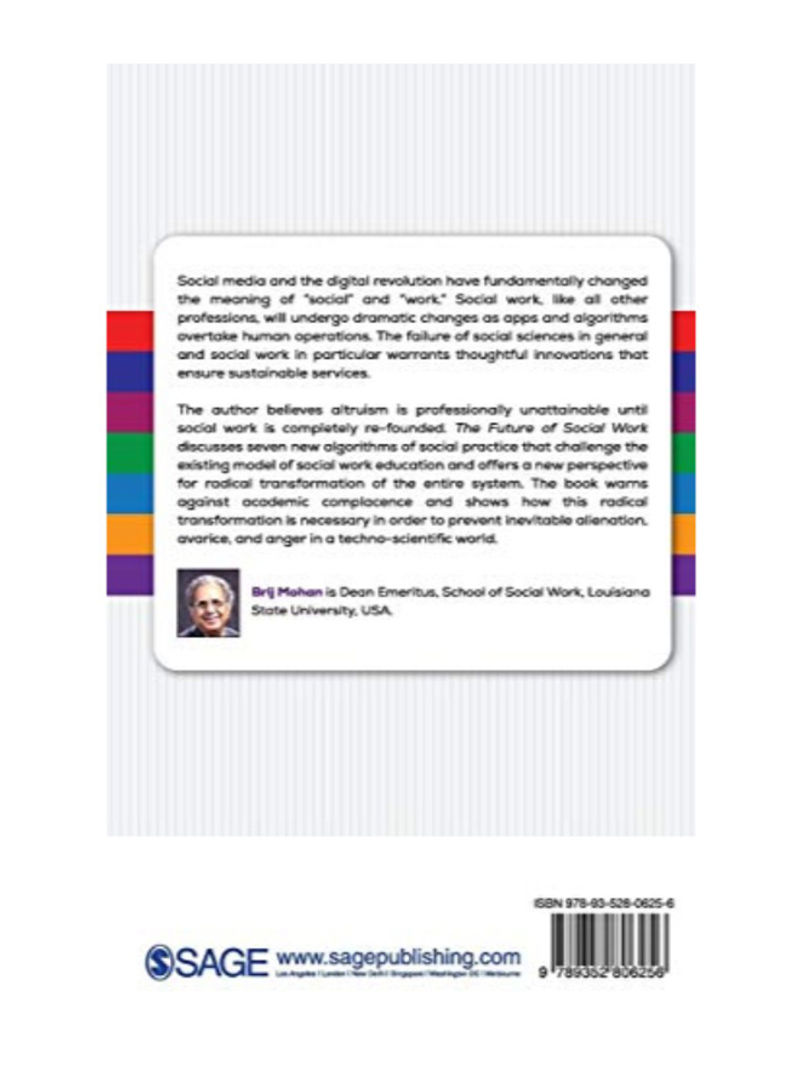
Social media and the digital revolution have fundamentally changed the meaning of “social” and “work.” Social work, like all other professions, will undergo dramatic changes as apps and algorithms overtake human operations. The failure of social sciences in general and social work in particular warrants thoughtful innovations that ensure sustainable services.The author believes altruism is professionally unattainable until social work is completely re-founded. The Future of Social Work discusses seven new algorithms of social practice that challenge the existing model of social work education and offers a new perspective for radical transformation of the entire system. The book warns against academic complacence and shows how this radical transformation is necessary in order to prevent inevitable alienation, avarice, and anger in a techno-scientific world.
ISBN-13
9789352806256
Language
English
Publisher
Sage Publisher
Number of Pages
184
About the Author
Brij Mohan is Dean Emeritus, School of Social Work, Louisiana State University, USA. Having taught at Lucknow University for over a decade 1964–1975), he moved to the United States of America where he served at the University of Wisconsin and Louisiana State University. He is Founding Editor of the Journal of Comparative Social Welfare now published as Journal of International and Comparative Social Policy). Professor Mohan has published many books and papers on issues ranging from existential social work to transformative social practice. He speaks and writes about the human condition with undying hope for the survival of family, community and the world at large. Professor Mohan received his Master of Social Work degree from Agra University. He received his doctorate from Lucknow University and an Honorary Doctorate of Letters from M.K. Gandhi Kashi Vidyapith.
Editorial Review
A master of social welfare, social work and comparative social policy has written a masterful book. Enough already of professional social work, it has denounced itself with decades of foolish accommodations, empty scholarship and even a wandering commitment to those in need. Unique in these sorts of analyses, Mohan asks for the consideration of elements outside of the ambience of social work but with a humane and humanistic commitment. Reflecting the modesty of his deep learning, he refrains from offering a vision. These sorts of things, following Huxley, in their reduction of complexity only produce dynasties of tyranny. Perhaps Mohan’s desire to ‘demystify the power of materialism at the expense of philosophical streams’ is best realized by first addressing the problems of social and economic inequality— two policies that are impeded by contemporary social work practice-William M. Epstein Professor, Social Work University of Nevada, USA.The Future of Social Work is a brilliant exposé of social work’s ontology and authenticity—a subject mostly untouched by intellectuals in the field. Brij Mohan re-examines the Legitimacy Crisis of his calling with courage and convictions strengthened only by his vast knowledge and experiences. The ‘heretic’ thrust of this unmatched opus may save social work from falling into the traps of competitive, market-based professionalization. Uberization of social services, as the author calls, is imminent unless professionals overcome their myopic and siloed view of their practices. The Future of Social Work calls for a return to the core values and principles of human-centred social practice, against dehumanizing patronizing practice, by adhering to the seven algorithms: mission, education, service, empathetic humility, liberatory assistance, transparent effectiveness and buoyance-Philip Young P. Hong, Director, Center for Research on Self-Sufficiency School of Social Work, Loyola University Chicago, USA.In The Future of Social Work, Professor Brij Mohan explores ‘plateaus of practice’ that believers might find unsettling. The book is a futuristic humane critique of contemporary professional ethics and practice. Mohan’s ‘Seven Pillars of Practice’ proffer a ‘liberatory praxis’ that snorkels the depths of knowledge in search of jewels of truth. As a philosopher of social hope, the author suggests a paradigm shift, thereby challenging social sciences and humanities to thwart the possibility of a dystopian future. Artificial intelligence will fundamentally change the patterns of social interactionality. Sapiens make mistakes; computers don’t. If human frailty can be reduced by techno-digital means, the delivery of social services can be mediated more efficiently without social agencies staffed by fallible workers. The future of self-driven cars is mainly based on this premise. Brij Mohan contends that designing obsolescence is crucial for progress. Students, educators and policy makers cannot ignore this seminal work by one of the most brilliant minds in academic discourse-Sonia Kapur Assistant Professor, International Studies University of North Carolina at Asheville, USA.