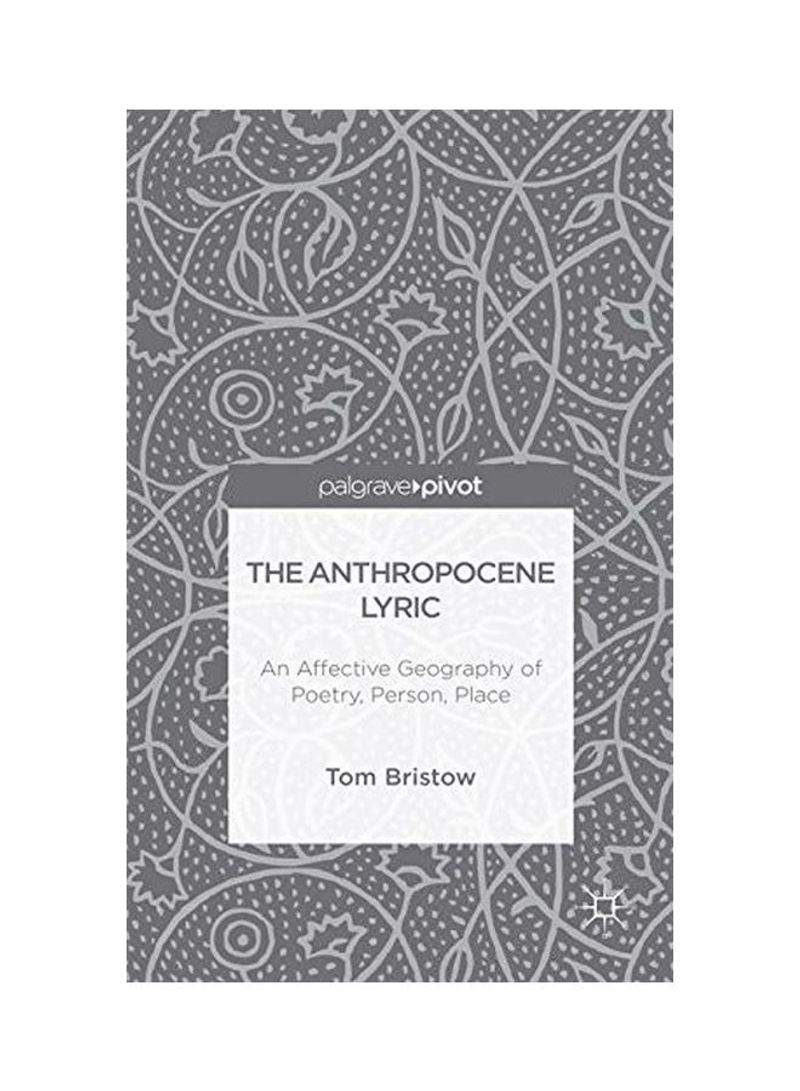


The Anthropocene Lyric Hardcover
Recommend
Sort by
Rating
Date
Specifications
Country of Origin
India
Author 1
Tom Bristow
Book Description
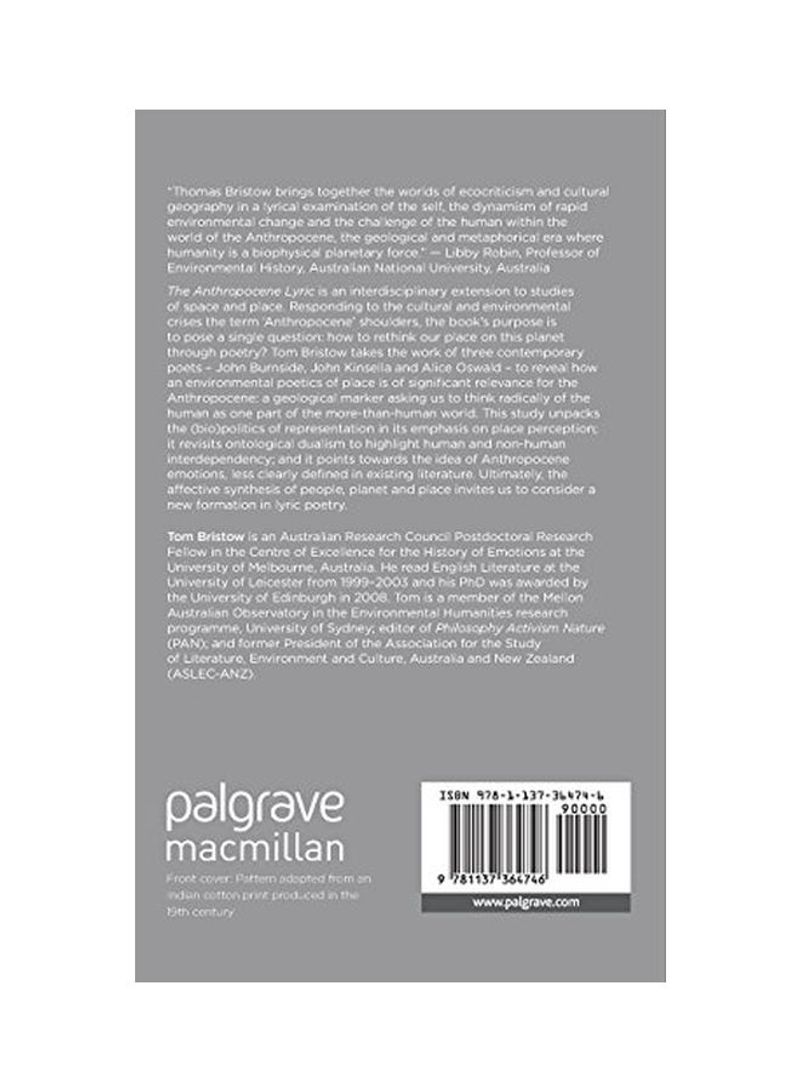
This book takes the work of three contemporary poets John Burnside, John Kinsella and Alice Oswald to reveal how an environmental poetics of place is of significant relevance for the Anthropocene: a geological marker asking us to think radically of the human as one part of the more-than-human world.
ISBN-10
1137364742
ISBN-13
9781137364746
Language
English
Publisher
Palgrave MacMillan
Publication Date
11 Jun 2015
About the Author
Tom Bristow is an Australian Research Council Postdoctoral Research Fellow in the Centre of Excellence for the History of Emotions at the University of Melbourne, Australia. He read English Literature at the University of Leicester from 1999-2003 and his PhD was awarded by the University of Edinburgh in 2008. Tom is a member of the Mellon Australian Observatory in the Environmental Humanities research programme, University of Sydney; editor of Philosophy Activism Nature (PAN); and former President of the Association for the Study of Literature, Environment and Culture, Australia and New Zealand (ASLEC-ANZ).
Editorial Review
Through a careful selection of writers and texts, The Anthropocene Lyric is a useful tool that can be used to explore the relationship between the human and more-than-human world within the context of the Anthropocene, where poetry has a firm foothold. (Veronica Fibisan, The British Society for Literature and Science, bsls.ac.uk, September, 2017)."Bristow's book is a significant, insightful and lyrical contribution to ecopoetic studies on many important levels." (Sue Edney, Green Letters - Studies in Ecocriticism, Vol. 21 (1), 2017)."The gambit of Bristow's book is that ecopoetry offers one path to a reconsideration of human positioning on earth. ... This is an excellent book, and one that confirms Bristow's place among the vanguard of ecopoetic theorists." (Mark Dickinson, Interdisciplinary Studies in Literature and Environment, Vol. 23 (3), November, 2016)